Shiwar News – Saturday, 17 October 2026
Reports about the closure of a border crossing between Iran and Pakistan in Balochistan, followed by denials from Iranian state-affiliated media, have created confusion and raised questions about contradictory official statements. Meanwhile, the head of the Chabahar Free Zone has announced that border trade has resumed and that the crossing is expected to return to normal operations in the coming days.
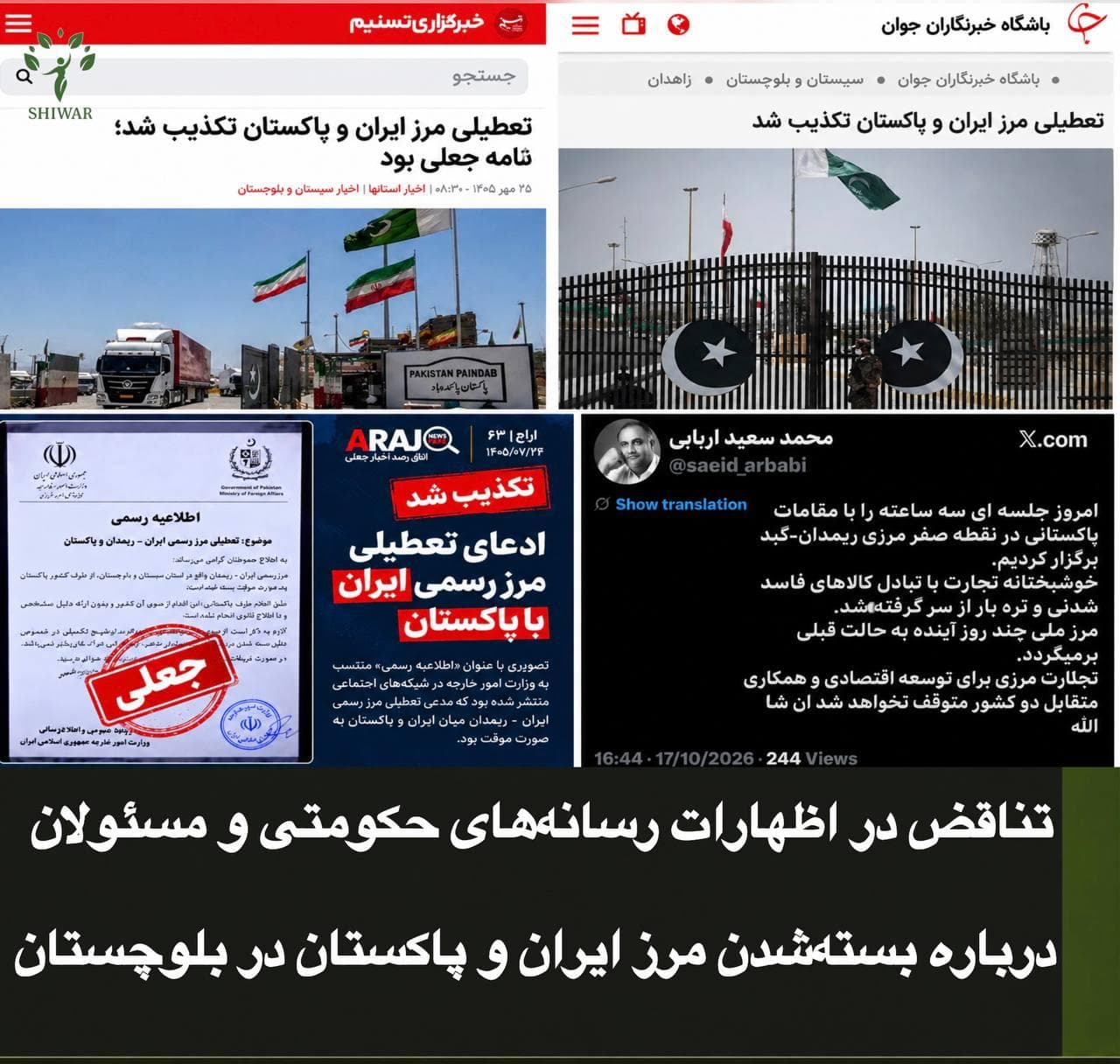
The previous day, an image of a letter allegedly issued by Iran's Ministry of Foreign Affairs circulated on social media. The letter suggested that the Rimdan–Gabd border crossing between Iran and Pakistan had been temporarily closed.
Following the circulation of the letter, the Tasnim News Agency and the Young Journalists Club published reports describing the document as fake and denying that the Iran–Pakistan border crossing had been closed.
These media outlets stated that the claims about the closure were false and urged social media users not to share unverified information.
However, at the same time as these denials, Mohammad Saeed Arbabi, head of the Chabahar Free Zone, announced on his X (formerly Twitter) account that he had held a three-hour meeting with Pakistani officials at the Rimdan–Gabd border crossing.
He wrote:
"Today, we held a three-hour meeting with Pakistani officials at the Rimdan–Gabd border point. Fortunately, trade has resumed with the exchange of perishable goods and fresh produce. The border will return to its previous condition within the next few days. Border trade for economic development and mutual cooperation between the two countries will not stop, God willing."
Arbabi's statements, particularly his references to trade having "resumed" and the border returning to its "previous condition" within days, indicate that commercial activities at the crossing had experienced some form of disruption or restriction.
This raises questions in light of the broad denials issued by state-affiliated media.
The contradictory information raises important questions about the actual situation at the Rimdan–Gabd crossing.
If border activities continued without interruption, what did the head of the Chabahar Free Zone mean when he referred to trade resuming and the border returning to its previous condition?
And if restrictions had been introduced, why were their nature and reasons not clearly explained to the public?
The Rimdan–Gabd border crossing is an important route for trade between Iranian Balochistan and Pakistan. Any disruption to its operations could affect the livelihoods of border residents, drivers, traders and other local economic workers.
What matters in this situation is the need for clear and accurate information about the status of Balochistan's border crossings.
Contradictory reports from state-affiliated media and officials, without a clear explanation of any restrictions that may have been introduced, can create confusion among residents and those involved in border trade and reduce public trust in official information.