Shiwar News – Saturday, 17 October 2026
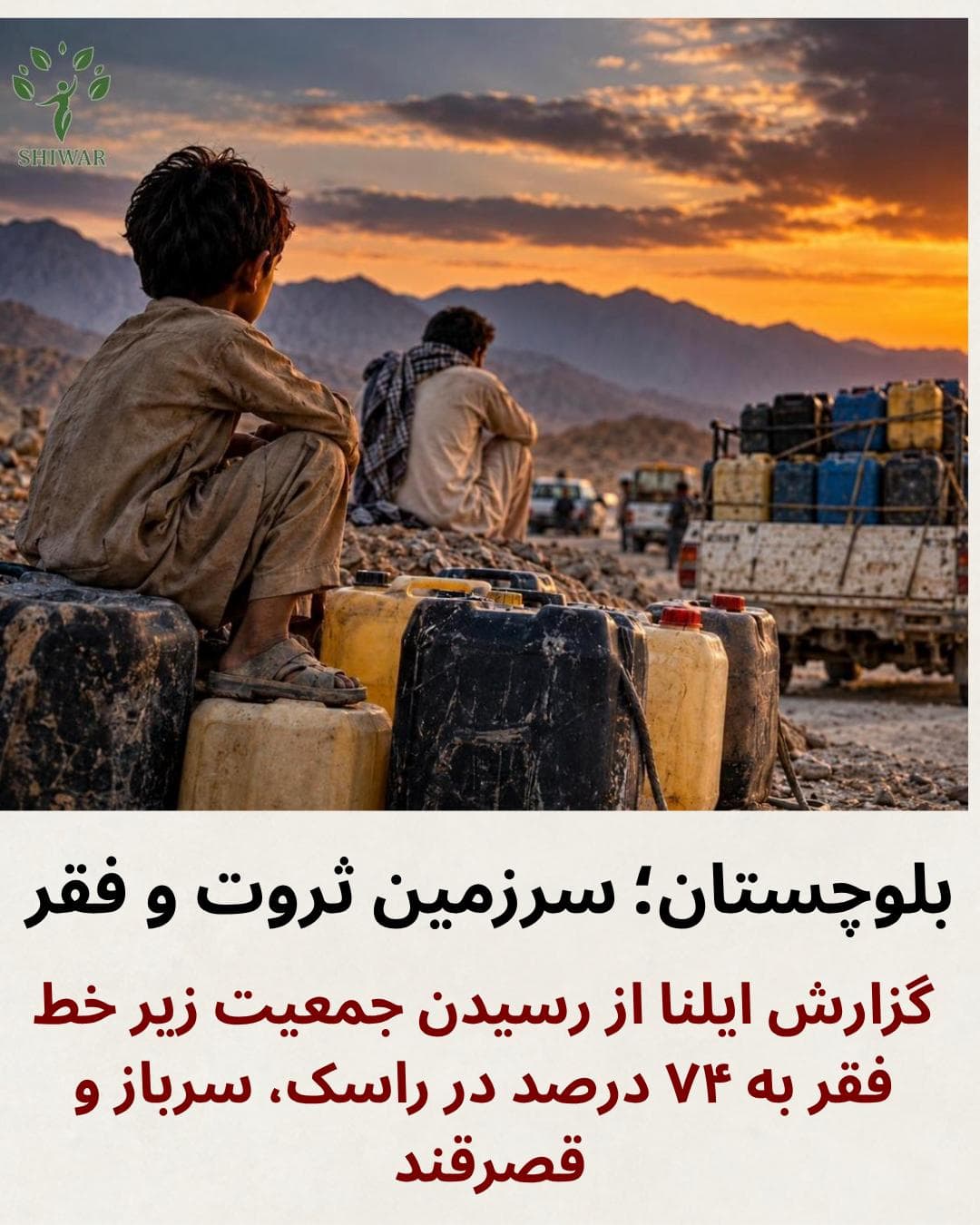
Despite its strategic border location, access to international waters, mineral resources, the port of Chabahar and potential opportunities for trade and transit, Balochistan continues to face deep economic and social problems. Widespread poverty, unemployment, a lack of stable job opportunities and unequal access to economic resources have affected the lives of a large part of the region's population.
Under these conditions, transporting fuel is not a freely chosen occupation for some families but a way to meet their most basic needs. It is a dangerous activity involving road accidents, fires, vehicle confiscation and the risk of being shot by military and law enforcement forces.
A recent report by the Iranian Labour News Agency (ILNA) on employment in Sistan and Balochistan has once again highlighted the scale of this crisis. However, poverty in Balochistan cannot be understood only through unemployment figures or the number of fuel transporters. The crisis is also connected to educational deprivation, inadequate infrastructure, drought, unequal access to economic resources and the lack of effective social support.
In a report dated 17 October 2026, ILNA stated that 54% of the population of Sistan and Balochistan lives below the poverty line, with the figure reaching 74% in areas such as Rask, Sarbaz and Qasr-e Qand. The report also gave a national poverty figure of 22%, but did not identify the original sources or explain the methodology used to calculate these figures.
Hossein Ali Akbari, executive secretary of the Workers' House in Sistan and Balochistan, also told ILNA that if people engaged in informal activities such as fuel transportation were counted as unemployed, he estimated that around 50% of the province's population would be unemployed.
As Akbari himself emphasised, this figure is his personal estimate, and the text argues that the actual rate is certainly much higher. Nevertheless, his comments raise an important question about the gap between employment statistics and the economic reality of households: Does having a temporary, dangerous source of income without insurance or job security mean that a person has decent employment?
In parts of Balochistan, limited economic opportunities have led some residents, including young people, to transport and sell fuel to earn a living.
In addition to natural and road-related dangers, this activity carries the risk of deadly encounters with military and law enforcement forces. Over the years, human rights organisations have documented numerous cases of Baloch fuel transporters being killed or injured by security forces' gunfire.
Under these circumstances, fuel transportation cannot be examined only as an issue of combating smuggling. We must ask what alternative employment opportunities have been created for people whose livelihoods and families depend on this activity.
Another important point in ILNA's report is the involvement of children in the dangerous activity of fuel transportation. Baloch activists and human rights organisations have warned about this issue for years, but it has not received serious or effective attention. This reality has now been raised again, this time by the executive secretary of the Workers' House in Sistan and Balochistan.
For many people in Balochistan, transporting fuel is not a job in the true sense of the word but a necessity caused by poverty, unemployment and the absence of alternative ways to earn a living.
Even children have not been protected from the consequences of this deprivation. Some enter this dangerous activity to help their families meet their most basic needs, putting their lives at risk at any moment.
In recent years, numerous reports have described the deaths of Baloch children in incidents connected to fuel transportation, including children who were burned alive when vehicles carrying fuel caught fire.
Some of these children were only 11 or 13 years old. Because of poverty and their families' difficult economic circumstances, they had to work as assistants to fuel transporters. Instead of sitting in classrooms, they travelled on dangerous roads to help support their families and lost their lives in vehicle fires.
These children had neither the opportunity to enjoy childhood nor access to their most basic rights. Instead of a safe future, they became victims of poverty, deprivation and the lack of livelihood opportunities.
The involvement of children in fuel transportation is not simply a matter of child labour. It also shows the depth of poverty and deprivation that denies children their rights to education, safety and childhood.
The question is why, despite repeated warnings from human rights activists, effective measures have still not been taken to protect these children and their families and create safe livelihood opportunities.
Balochistan has significant mineral and commercial potential, but a region's natural resources do not automatically mean that its residents benefit from economic opportunities.
ILNA's report refers to demands from local communities concerning recruitment and economic participation at the Taftan gold mine.
According to the provincial Workers' House executive secretary, people living near the mines expect not only to bear the environmental consequences of mining activities but also to benefit from employment opportunities, technical training, insurance and service contracts.
These demands raise a broader question: What share of the income and economic opportunities generated by projects in their areas actually reaches local communities?
Widespread poverty in a region with considerable economic potential raises serious questions about development policies, resource distribution, public investment and the responsibilities of government institutions.
The problem is not only the lack of jobs. The quality of employment opportunities, equal access to education and skills training, insurance coverage, job security and the ability of local people to participate in economic decision-making are equally important.
The impact of security policies on economic activities in border areas must also be considered.
When some residents depend on fuel transportation to survive, a purely security-based response, without providing alternative employment opportunities, cannot address the economic causes of the problem.
The crisis of poverty and unemployment in Balochistan cannot be explained only through statistics, welfare payments or measures against informal economic activities.
What requires investigation and accountability is why economic deprivation continues in a region with significant mineral, port, commercial and human resources.
The central question is why some people in Balochistan continue to struggle to meet their most basic needs while living alongside major economic resources and projects, and why safe, stable employment opportunities that respect human dignity have not been made available to many of them.
Until these questions are addressed through effective policies, transparency and genuine participation by local communities, the risk of continuing poverty, the expansion of dangerous occupations and the deprivation of future generations will remain.