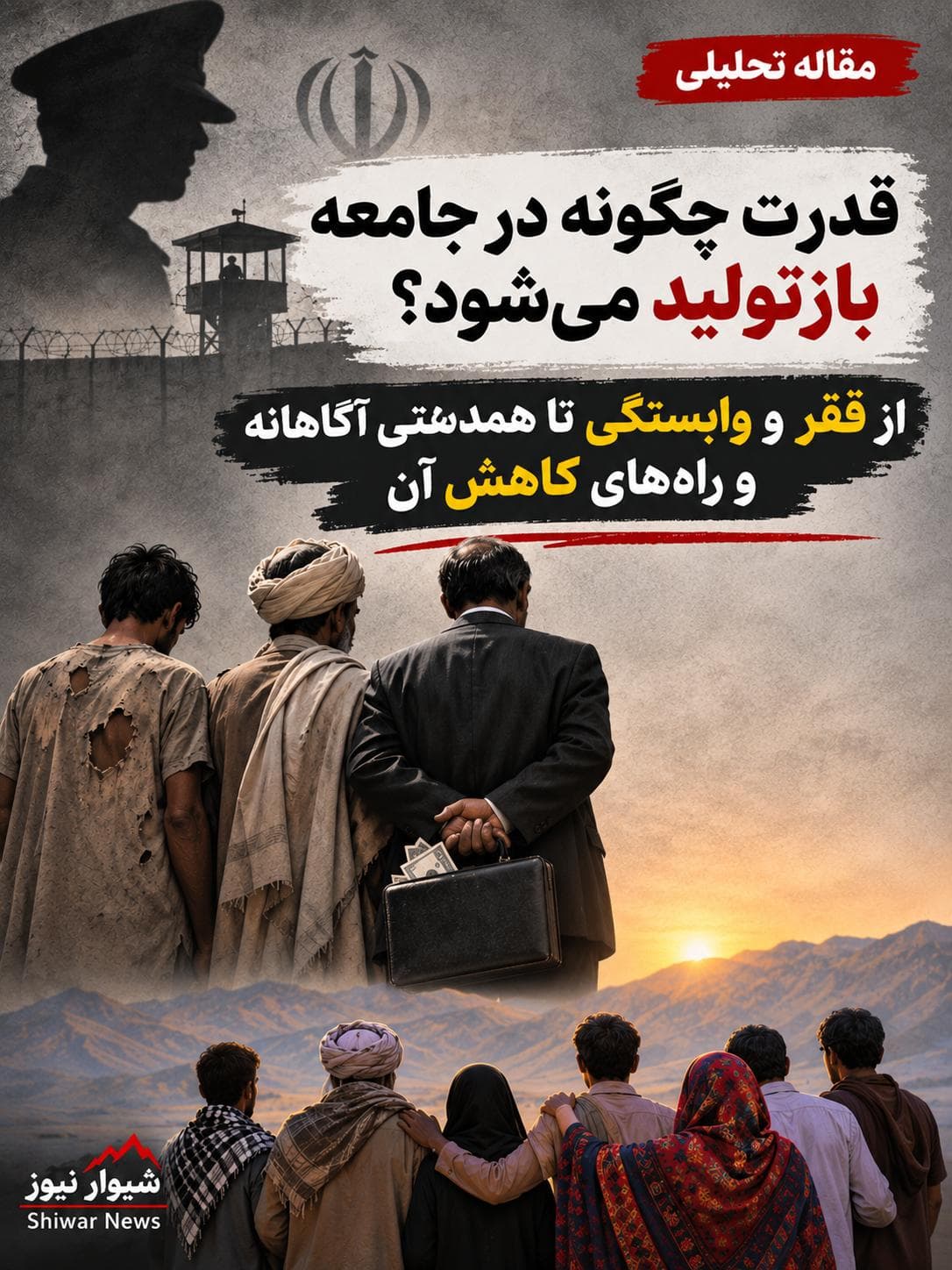
Shiwar News | Analytical Article
When we speak about power and repression, we usually think of governments, military and security forces, prisons, and violence. Yet repressive governments do not maintain their power solely through coercive means. Economic relationships, social dependencies, and the cooperation of certain influential individuals and institutions within society can also contribute to the continuation of repressive structures.
This issue becomes particularly important in societies affected by poverty, discrimination, unemployment, and unequal access to resources and services. However, it is essential to distinguish between those who are pressured into cooperation through poverty and threats and those who consciously participate in repression to gain wealth, status, or influence.
This article examines how power is reproduced within society, the role of poverty and personal interests in creating dependency, and ways to reduce these dependencies, with particular attention to the circumstances of Balochistan.
A quotation attributed to Simone de Beauvoir, the French writer and philosopher, states:
“The oppressor would not be so powerful if he did not have accomplices among the oppressed themselves.”
This quotation raises an important question: how can repressive governments maintain their power for many years?
When discussing power and repression, the first things that usually come to mind are governments, military forces, prisons, weapons, and violence. However, power is not sustained through force alone.
Repressive governments cannot control every part of society solely by relying on military and security forces. To maintain their power, they also depend on networks of individuals and institutions within society.
These networks may include influential local figures, economic intermediaries, and people with greater access to resources and opportunities who use their positions to influence the lives of others.
For example, imagine a region where having connections with an influential person is more important than qualifications or genuine need when seeking employment or accessing essential services. If access to these opportunities becomes conditional on supporting those in power, economic dependency can become a means of controlling people's behaviour.
Under such circumstances, a government maintains its power not only through security personnel and institutions but also through economic relationships and dependencies that develop within society.
An important distinction must be made here. Not everyone who works in a government department or institution, or earns an income through an organisation associated with the government, is necessarily complicit in repression or seeking illegitimate benefits. People need employment and income to support themselves and their families, and many public-sector employees provide essential services to society.
What matters is the nature of an individual's actions and role: whether they consciously use their position to threaten others, discriminate against them, deprive them of their rights, or assist in repression.
Furthermore, not everyone who becomes involved in relationships of dependency or cooperation with those in power faces the same circumstances.
Some people may be pressured by poverty, fear, and the need to provide for their families, while others may consciously participate in repressive practices to obtain wealth, status, recognition, or personal benefits.
Understanding the difference between these two situations is essential to understanding how power is reproduced within society.
To understand how poverty and people's basic needs can become instruments for maintaining power, we must first consider the responsibilities of governments towards their citizens.
One of the fundamental responsibilities of governments is to respect people's economic and social rights and create conditions for fair access to education, healthcare, employment opportunities, and public services.
Access to these services and opportunities should not depend on connections with influential individuals or political loyalty.
Education, healthcare, and equitable access to public services are people's rights, not favours granted by those in power.
However, under repressive governments, access to jobs, economic resources, and essential services may be controlled by networks closely connected to those in power. In such circumstances, something that should be a citizen's right becomes a privilege that requires the approval of influential individuals.
When governments or networks associated with them make access to these opportunities conditional on political support or cooperation, they can exploit people's basic needs to create dependency and control their behaviour.
A hypothetical example helps illustrate this situation.
Imagine a young man living in a disadvantaged region. He wants to work and build a future for himself, but employment opportunities are extremely limited. His father is ill, his family has no stable income, and despite considerable effort, he has been unable to find a job.
Under these circumstances, someone connected to a powerful institution offers him employment. Initially, the offer appears to be an opportunity to support his family. However, after some time, he is asked to gather information about others, participate in intimidating people, or support actions that violate other people's rights.
The young man now faces a difficult situation. On the one hand, his family depends on his income. On the other, complying with these demands may cause harm to others.
Refusing these requests could mean losing his only source of income. Although he appears to have a choice, poverty and economic dependency have severely restricted his ability to make a genuinely free decision.
This issue becomes particularly significant in regions that have experienced years of poverty, unemployment, discrimination, and inadequate access to essential services.
In parts of Balochistan, economic deprivation, limited employment opportunities, and unequal access to public services have affected the lives of many families.
When economic opportunities are scarce and access to resources and services is controlled by influential individuals or institutions, some people may become dependent on them to meet their basic needs.
If this dependency becomes conditional on political support, gathering information about others, or participating in repressive activities, poverty and deprivation become instruments for maintaining power.
To establish that such abuses have occurred in specific cases, it is necessary to rely on verifiable evidence and accounts.
At the same time, people who are pressured into cooperation to support their families or protect themselves from threats should not be treated in the same way as those who freely participate in repression for personal gain.
Ordinary people are not responsible for creating poverty, discrimination, or unequal social structures. Primary responsibility for repression rests with those who design, order, or carry it out.
This does not mean ignoring the harm that individuals may cause through their cooperation. Rather, it means taking that harm seriously while also considering the circumstances and degree of freedom available to individuals when assessing their actions.
Nevertheless, not all cooperation results from poverty, necessity, or coercion. Another group consists of individuals who, despite having greater resources and freedom of choice, consciously seek closer relationships with repressive structures to obtain wealth, status, and influence.
Alongside those whose freedom of choice is restricted by poverty, threats, and economic dependency, there are individuals who cooperate with repressive structures not out of necessity but consciously, in pursuit of wealth, status, influence, and personal gain.
For example, imagine someone who already enjoys a relatively secure financial and social position but seeks closer relationships with those in power to obtain a higher position, lucrative contracts, or special privileges.
To preserve these benefits, that individual may support unjust decisions, justify the repression of others, or even participate in carrying it out.
Of course, working in a government office or maintaining relationships with officials does not, in itself, constitute complicity in repression. People need employment and income to support themselves.
The concern is with those who consciously use their positions and influence to violate the rights of others or assist in implementing repressive policies in exchange for privileges.
One example of this type of cooperation can be found in the relationships between governments and certain influential local figures.
A person who enjoys credibility within a community may help legitimise an unjust decision by supporting it or may reduce public opposition to that decision.
If such an individual consciously uses their social standing to justify repression in exchange for money, a position, or other privileges, they are effectively placing their social influence at the service of those in power.
In the Islamic Republic of Iran, networks connected to power can also link the interests of certain individuals and groups to the continuation of the government through privileged access to economic resources, contracts, administrative positions, and political benefits.
Under such circumstances, those who benefit from these relationships may support unjust policies or participate in implementing them to protect their privileges.
This issue is particularly significant in Balochistan.
In a society where people face economic deprivation, discrimination, and limited opportunities, the conscious cooperation of influential individuals with repressive policies can cause additional harm to communities.
This is especially true when someone uses the difficulties and needs of the very people they are expected to represent or support as a means of obtaining personal benefits, rather than using their position to defend the community's rights.
However, the consequences of this type of cooperation are not limited to one person or one family.
When individuals help implement unjust policies to protect their positions and personal interests, they can make it more difficult for people to protest and demand their rights, increase mistrust within communities, and contribute to the continuation of discrimination and de